
The Veritas Method®
The Veritas Method® is not a prompt library, a productivity hack, or a fixed set of tools. It is a Human-AI operating system for the intelligence age. Its job is to help you engage AI with greater clarity, stronger judgement, and more compounding benefit over time.
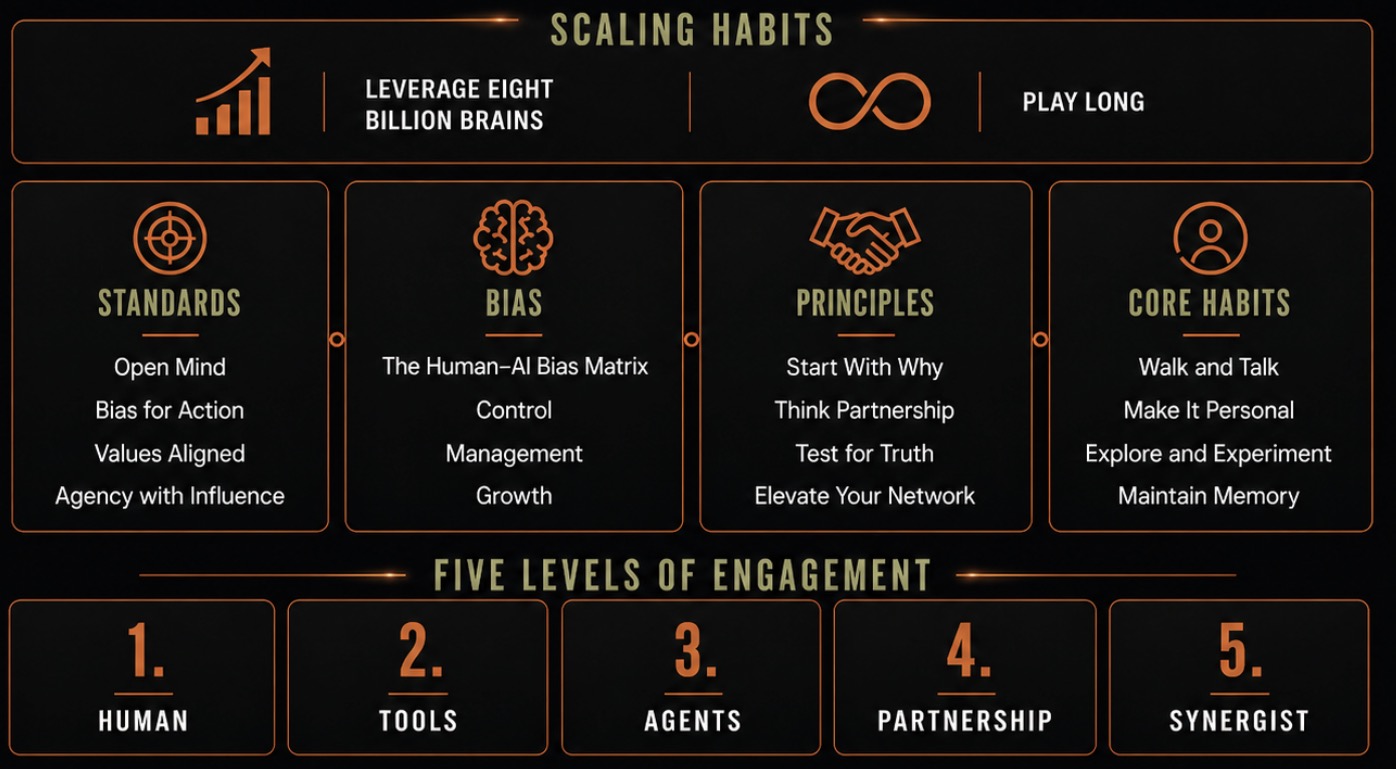
The revised structure is deliberately simple. The Method is organised around five elements:
- Engagement, the five levels that describe how people actually work with AI.
- Standards, the qualities you must bring if the partnership is to be worthy of trust.
- Bias, the pattern of human and AI involvement you are creating.
- Principles, the thinking disciplines that guide sound use.
- Habits, the repeated practices that turn intention into capability.
System shapes outcomes
People often assume outcomes are mainly a function of effort. In practice, outcomes are far more strongly shaped by system design. If your method rewards speed over reflection, you will get superficial answers faster. If your method rewards truth, memory, iteration, and challenge, you will get better thinking, better decisions, and better action.
This is why structure matters. The Veritas Method® is designed so that each element reinforces the others. The Five Levels of Engagement show you where you are. Standards set the quality threshold. Bias helps you diagnose the pattern you are creating. Principles shape how you think. Habits make the whole thing operational.
Element 1, Engagement
The first element is Engagement, expressed through the Five Levels of Engagement: Human, Tools, Agents, Partnership, and Synergist. These levels are not badges; they are a map. They show how responsibility, context, initiative, and value creation shift as the relationship deepens.
The levels matter because many people believe they are partnering when they are merely using tools. Others move into automation without first building the judgement needed to govern it well. The map protects against both confusion and overconfidence.
Element 2, Standards
Standards answer a simple question: who do you need to be for this partnership to work well? The four standards are Open Mind, Bias for Action, Values Aligned, and Agency with Influence.
Without standards, capability becomes dangerous. You may have access to advanced models, but you will still get weak outcomes if you are closed, passive, misaligned, or unwilling to act. Standards are the human quality threshold that makes the rest of the Method reliable.
Element 3, Bias
Bias in this context is not a moral accusation. It is a directional force. Every working pattern creates a bias. Some patterns keep too much with the human. Some surrender too much to the machine. Some never move at all.
The Human-AI Bias Matrix helps you see which pattern you are reinforcing. The goal is not maximum AI involvement or maximum human control in isolation. The goal is Optimal Partnership, where meaningful human engagement and meaningful AI engagement combine.
Element 4, Principles
Principles provide the Method's intellectual discipline. They keep the partnership from becoming reactive or shallow. The four principles are Start With Why, Think Partnership, Test for Truth, and Elevate Your Network.
Principles help you decide what deserves attention, how to frame the work, how to interrogate the output, and how to widen the range of intelligence available to you. They are the difference between using AI to accelerate habit and using it to elevate judgement.
Element 5, Habits
Habits are where the Method becomes real. They translate insight into consistent behaviour. The six habits are Walk and Talk, Make It Personal, Explore and Experiment, Maintain Memory, Leverage Eight Billion Brains, and Play Long.
Habits matter because transformation is rarely produced by a single brilliant interaction. It is produced by repeated, deliberate practice. The person who returns to the Method, carries context forward, experiments honestly, and compounds learning over time will not merely use AI differently; they will think differently.
How the five elements work together
The Method works because the elements are integrated. Standards without habits remain aspiration. Habits without principles become motion without direction. Bias without engagement is hard to diagnose. Engagement without standards can scale weakness.
Together, the five elements create a practical operating system for individuals, teams, and organisations. They help you move beyond fascination with AI and into mature, useful, accountable partnership.