
Bias
Every Human-AI workflow develops a bias, whether intentional or not. Bias here means the pattern created by the balance of human involvement and AI involvement. Some patterns lead to better partnership. Others create fragility, passivity, or stagnation.
The purpose of the Bias element is to make those patterns visible. Once you can see the pattern, you can change it.
The Human-AI Bias Matrix
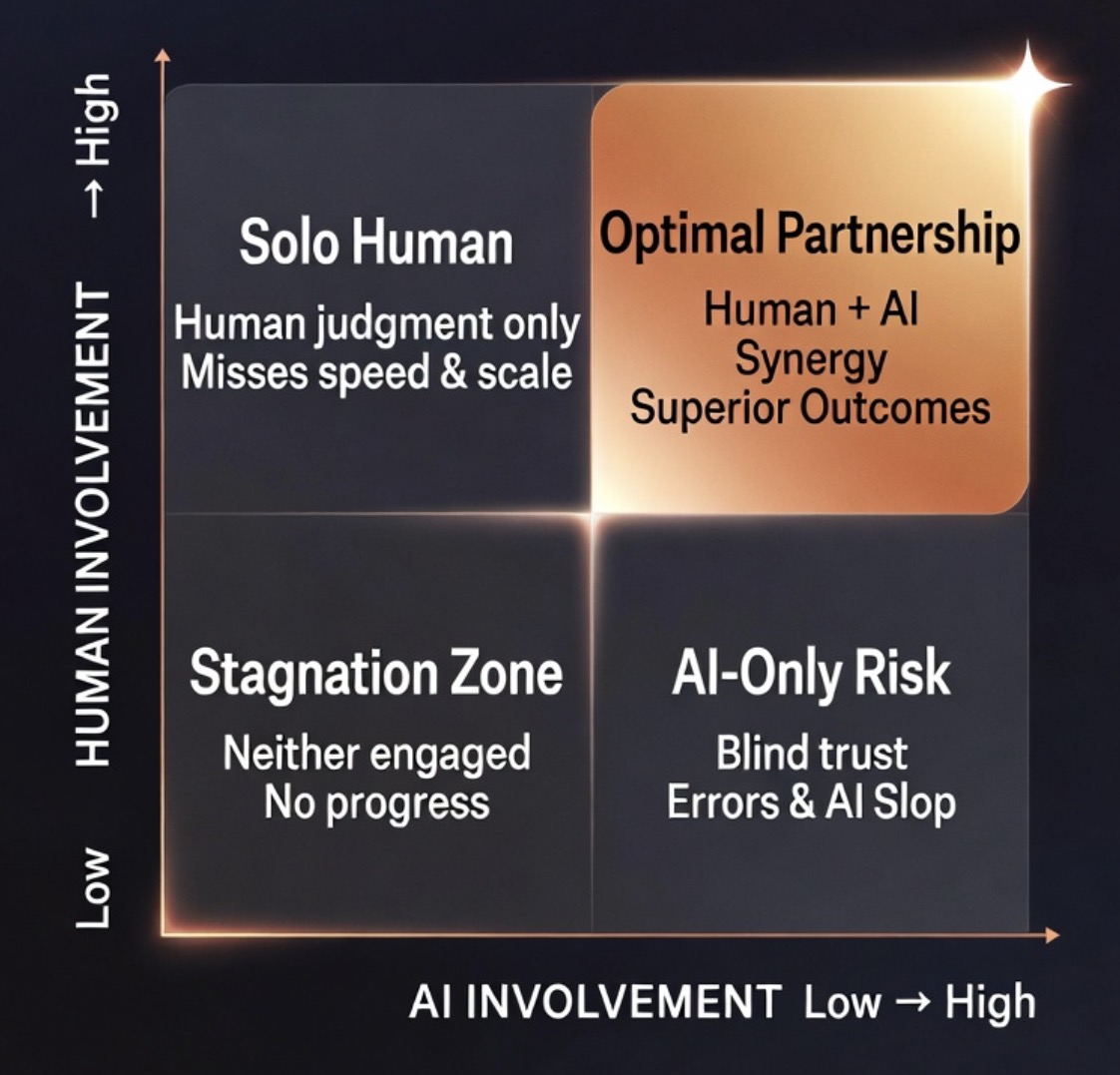
The matrix is built on two axes: the degree of meaningful human involvement, and the degree of meaningful AI involvement. These two dimensions create four operating zones.
Optimal Partnership
Optimal Partnership is the zone to aim for. Human involvement is high, AI involvement is high, and each side is contributing what it does best. The human brings context, judgement, values, discernment, and accountability. The AI brings pattern recognition, speed, synthesis, breadth, and generative support.
This zone is not about control for its own sake. It is about productive interplay. The human does not disappear, and the AI is not reduced to a trivial assistant.
Solo Human Constraint
Solo Human Constraint appears when human involvement is high but AI involvement is low. This often looks respectable because it feels self-reliant, but it imposes an unnecessary ceiling. The person is carrying too much alone, missing the amplification available through partnership.
This zone can feel safe, but it usually produces slower thinking, narrower option sets, and lower leverage.
AI-Only Risk
AI-Only Risk appears when AI involvement is high but human involvement is low. This is the zone of over-delegation, over-trust, and borrowed judgement. It can feel efficient in the short term because outputs arrive quickly and with confidence.
The deeper risk is that the human stops doing the cognitive work needed to govern the relationship properly. Accuracy, alignment, and accountability all become unstable.
Stagnation
Stagnation appears when both human involvement and AI involvement are low. The system is underused, under-thought, and under-developed. There is little experimentation, little challenge, and little compounding.
This is the zone where organisations claim to be engaging AI, but very little has actually changed.
Reading the pattern honestly
The Bias element matters because people tend to misread their own behaviour. They assume activity equals progress, or that convenience equals effectiveness. The matrix gives you a more rigorous diagnostic lens.
The aim is not to remain permanently in one perfect square. Different tasks require different balances. The real discipline is to notice when a pattern has become your default, then move deliberately towards stronger partnership.