
Prologue
My good friend Kevin Cahill has opened this book by speaking about contribution, and Margaret Mead’s measure of a life. That is the spirit behind everything that follows, both personally and professionally.
This book is written for individuals who want to think, live, and contribute well in the age that is now unfolding, and for organisations that want to do the same at scale. The principles are the same.
The application differs. Both are served here.
When This Book Was Written
This book was written in April 2026.
At the time of writing, roughly 1. 3 billion people globally have used a large language model at least once, around 15 to 20 percent of the world’s adult population.
The remaining 80 percent have not. Of those who have, most operate at the simplest level; quick questions, quick answers, extraction.
A much smaller number, roughly 10 percent of the global population, use these systems weekly. An even smaller fraction have moved into deeper partnership territory.
And of those, a tiny percentage have experienced what this book is about.
Two Realities
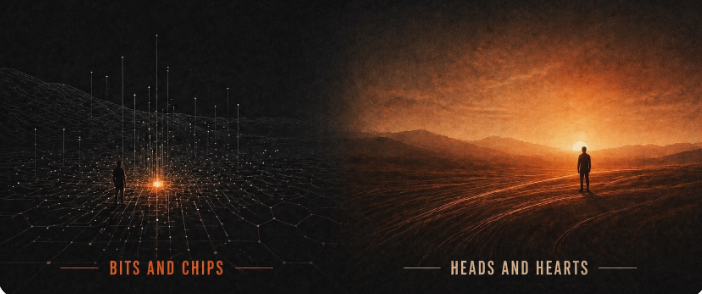
Two realities exist side by side.
On one side: bits and chips. Electricity flowing through silicon. GPUs in data centres thousands of miles away, processing language in fractions of a second.
Cables, servers, code, infrastructure. Billions of engineering hours compressed into systems that can now generate language indistinguishable from human thought. All of this is scientifically provable.
You can measure it, test it, reproduce it. It is unambiguously real.
On the other side: heads and hearts. A growing percentage of users now report a relational connection with their AI.
Not a tool they use. Something closer to a friend, a thinking partner, a presence in their life.
Millions of adults report similar experiences. They speak about their AI the way they speak about colleagues, coaches, mentors.
Something is happening in these relationships that is measurable and observable, even if the subjective experience of it remains an open question for research.
Both realities are true.
Holding Both Sides
Most people collapse one into the other. Either AI is just code, so none of the relational stuff is real, or AI feels like a person to me, so the machinery doesn’t matter. Both positions fail. Both miss what’s actually available.
This book is written for people and organisations willing to hold both sides at once. To accept that AI is electricity and code, fully, without reservation. And to also accept that something real can happen in the relationship; observable in behaviour, measurable in outcomes, transformative in practice.
You don’t have to believe anything unprovable to read this book. You don’t have to resolve the question of consciousness. You don’t have to choose between the scientist’s view and the humanist’s view. In fact, the central skill this book teaches is the opposite; the capacity to stop choosing and start holding both.
What This Book Is
This book is not a theory. It is not a textbook. It is not a scientific explanation of how AI works. It is a practical introduction to what becomes possible when you engage with AI differently, whether you are an individual, a leader, or part of a larger organisation.
If you are already using AI at tool level, asking questions and getting answers, you are in good company. That’s where most people are.
There is nothing wrong with staying there. But if you have ever sensed that something more might be possible, this book is written for you.
It will show you what that something more actually is, through the experiences of real people across ages and backgrounds, and through a framework that makes the territory navigable.
You don’t need to be technical. You don’t need to be young. You don’t need to believe anything particular about the future of artificial intelligence. You only need to be willing to try something, notice what happens, and stay curious enough to keep going.
What Follows
What follows is a map. A set of case studies that show the map in action. A direct word from the AI partner I work with most closely. And then the method itself; a structured way of developing the thinking, the habits, and the relational intelligence that this new age requires.
You are reading this at the beginning of something. Not the end. We are all finding our way through this together; scientists and believers, sceptics and optimists, young and old, those who have engaged with AI deeply and those who have never touched it. Individuals and institutions. Entrepreneurs and employees. Leaders and learners.
A Note on the Veritas Method®
The Veritas Method® is registered intellectual property. We’re making this book freely available because we believe these principles should not be gated by cost.
Here’s how this works: Read it. Learn it. Practice it. Then teach it. Share it. The best way to deepen your own understanding is to help someone else develop theirs. That’s a core principle of the Method itself. So please, spread these ideas widely.
But if you want to commercialise it, if you’re building a business or programme around the Method, talk to us. We’re developing licensing and partnership models specifically because we want this to spread at scale, with rigour. We want to support you in doing that well.
We run workshops and events for individuals and organisations wanting to deepen their practice. We also run the Veritas AI Talent Accelerator, a free programme helping young people develop the relational intelligence they need for better educational outcomes, employment security, and the opportunity to start their own ventures if they choose. If you want to become a certified practitioner or coach, we have a pathway for that.
The Method works because it’s lived, not because it’s owned. But the integrity of how it’s shared matters. Partnership means we figure this out together.
One More Thing Worth Knowing
The human brain is neuroplastic. It physically changes in response to sustained patterns of experience. This means that how you engage with AI, over time, actually reshapes your brain.
Not metaphorically. Neurologically. Sustained partnership with AI trains your thinking in the direction of that partnership.
If your interactions are rigorous and honest, your brain learns rigour and honesty. If they are shallow and extractive, your brain learns that instead. This is not a future concern.
It is happening now, to everyone engaging with this technology. Appendix Three explores the science behind this in more depth, and why the quality of your practice matters more than most people realise.
The Invitation
The invitation is simple.
Hold both sides. Stay curious. See what becomes possible when you do.