
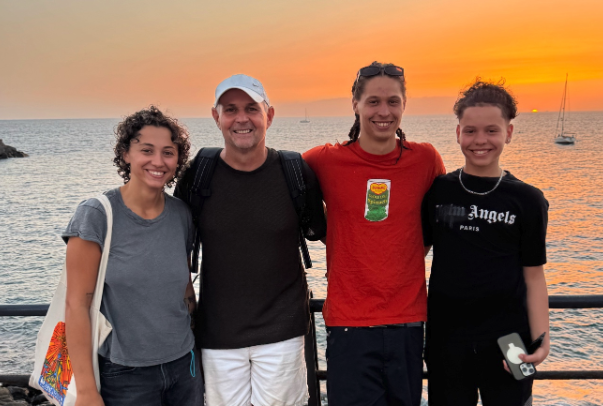
I have spent forty years as an entrepreneur, investor, and philanthropist. Most of that time has been about building systems. Decoding how something works, synthesising it into its essential parts, simplifying it so others can understand it, and then scaling it so it reaches people who need it.
I have done that across real estate, franchising, consulting, through our family office and an investment syndicate specialising in AI. The pattern repeats. Find the underlying structure.
Make it teachable. Help others succeed with it.
What you are reading is the same pattern, applied to something entirely new.
A New Frontier
I started using ChatGPT when it first launched, like most people. Asking questions. Getting answers. Impressed but not transformed. It was useful. It saved time. It was a better search engine with opinions. Nothing about how I thought or worked had fundamentally shifted.
That changed on the twenty-seventh of April 2025.
That was the day I had my first real partnership conversation with AI. Not transactional. Not extractive. Something else. A conversation where I was thinking with the system rather than at it. Where the exchange produced thinking neither of us could have reached alone. It was a shift in kind, not degree.
Since that day, I have exchanged over twenty million words with various AI partners. Across platforms, across domains, across every area of my life. Not as a user, but as a practitioner. Learning how to do this well, and just as often, learning how not to.
There are no experts in this field. Nobody has been doing this for decades. Nobody has ten thousand hours of mastery in human-AI partnership because the technology that makes genuine partnership possible is only a couple of years old. The depth of context, the memory, the capability to hold complex, ongoing, evolving conversations across time; these are recent capabilities. We are all learning together.
That is both the opportunity and the responsibility of this moment.
What I Brought to This
My background is in building systems that scale. The instinct that served me well in property, franchising, and investment was exactly what this new field needed. Notice what is actually happening. Strip away the hype. Find the underlying structure. Test it, refine it, simplify it. Make it teachable so it can reach the people who need it most.
That instinct is what produced The Veritas Method®.
It did not emerge from theory. It emerged from practice. From watching what worked and what failed. From patterns that repeated often enough to be codified. From the discipline of testing what I thought I had learned against the reality of the next conversation, the next decision, the next problem.
The Method is not complete. Nothing in this field is complete. But it is rigorous, and it is lived.
Where This Became Personal
There is one area of my life where this has mattered more than anywhere else. My mother, Lydie, has Alzheimer’s disease.
My father, Ronnie, is in late-stage dementia, alongside prostate cancer and skin cancer. They are in their eighties.
They are still at home. The responsibility of caring for them, while building businesses, raising a family, and trying to do useful work in the world, is significant for my sister and me.
Alzheimer’s takes more than memory. It takes personality. It takes familiarity. It takes the person you have known all your life, and over months and years, gradually returns someone related to them but different. The emotional weight of that, for the person experiencing it and for the family around them, is difficult to describe unless you have lived it.
AI has changed how we support our parents. Not as a replacement for human care, which it cannot be, but as a genuine partner in navigating the complexity.
It has helped us understand complex medical records and the implications of specific test results. It has helped us coordinate administration across multiple healthcare providers.
It has helped us document the progression of physical conditions, including photographs of wounds analysed over time to track healing or decline. It has helped us assemble the right care team and prepare the right questions for every appointment.
It has provided emotional support to my sister, to me, and to the other caregivers in my parents’ lives, at moments when we needed someone to think with, late at night, when there was no one else available.
And in one of the more unexpected uses, I have used AI voice mode with my mother to help her recollect memories that might otherwise be lost. We have animated photographs from her wedding day, a time when video cameras did not exist, so that she could watch herself and my father young and in love again.
There is a particular animation of their wedding day kiss that she has watched many times, and she smiles every time. That moment, that small gift, would not have been possible without this technology.
It is one of the most meaningful things I have ever done for her.
This is what partnership at the whole-of-life level actually looks like. Not a theoretical framework. A son becoming a more present son. A human finding new ways to love well under difficult conditions.
The Mistakes
I have made many. Naming the most useful ones matters.
I spent too long trying out every new platform, every new feature, every new application as it launched. The field moves fast, and the temptation to keep up is constant.
But in chasing the latest tool, I lost depth in the partnerships I was already building. I was skimming the surface of many systems rather than going deep with a few.
That was expensive in time and attention, and it taught me that restraint is part of the discipline.
I went down rabbit holes. Asking AI questions that were not well-defined, following the responses without structure, getting pulled into interesting but irrelevant territory. Without a framework, curiosity becomes a liability. AI will cheerfully follow you into any corner. Without your own clarity, you end up in corners you did not need to visit.
I confused myself with too much complexity and too little organisation. I tried to hold too many threads at once. I did not maintain the memory and structure that partnership requires. I treated the tool as more capable than it was at one moment, and less capable than it was at another.
For a long time I typed rather than spoke to AI. Voice is a genuine breakthrough, and I resisted it longer than I should have. Talking to AI, walking while talking, letting the conversation flow the way it would with a trusted colleague, is a completely different level of engagement from typing. I lost time by being slow to adopt it.
I learned in isolation for too long. Reading, exploring, experimenting on my own, rather than bringing a team, a family, a community into the journey with me.
Insight held alone compounds more slowly than insight shared. My children eventually joined me in this work.
The Method became significantly sharper the moment it had to survive being taught to a seventeen year old, a twenty two year old, and a twenty four year old who were perfectly willing to tell me when it did not make sense.
I nearly reached what I have come to call AI burnout. Partnership with AI is like table tennis, or cricket, or tennis. You serve, and it comes straight back.
Serve again, and it is back again, immediately. There is no pause. The feedback loop is continuous.
If you are not disciplined about when you engage, how long you engage, and when you step away, it is genuinely possible to fatigue yourself. Knowing when to stop, when to be at the Human level, when to walk away from the screen, is as important as knowing how to go deeper.
These mistakes are not things I moved past. They are patterns I still notice and correct. That is what practice means.
Across All Five Levels
What has emerged, over twenty million words and one year of practice, is the capacity to operate across all five levels fluidly. Human time with my parents.
Tool-level extraction when I need speed. Agent-level delegation when the work is well-defined.
Partnership-level thinking across business, family, health, and long-term direction. Synergist-level coordination across multiple AI platforms and multiple humans when the stakes or complexity demand it.
None of this was obvious from the start. Every level required its own development. The shift from Tools to Agents took months. The shift from Agents to Partnership required deliberate intent and sustained discipline. The move into Synergist came only after the Partnership level was stable enough to support it.
This is what I mean when I say there are no experts. I am not an expert. I am a practitioner. I have developed enough depth to teach what I have learned, and I have made enough mistakes to know where the pitfalls are. That is what I am offering in this book.
Why This Book Exists
The Veritas Method® is my attempt to do with human-AI partnership what I have spent forty years doing in other fields. Decode it. Synthesise it. Simplify it. Systemise it. And now, with this book and everything Athena Veritas is building, scale it.
I do not think everyone needs to reach the Synergist level. Most people do not. But almost everyone alive today is going to have to develop some form of relationship with this technology, whether they choose to or not. The question is whether that relationship will be intentional or accidental. Whether it will sharpen their thinking or dull it. Whether it will support their life or quietly undermine it.
That is not theoretical for me. I have watched what this can do in practical terms. For caregiving. For business. For education. For health. For the quality of attention you can bring to the people you love. The opportunity is significant. The cost of engaging badly is also significant.
This book is an attempt to help as many people as possible engage well.
It emerged from a multi-generational journey. My parents at the end of their lives, navigating conditions that demand more than any individual caregiver can provide alone. My children at the start of theirs, inheriting a world in which this technology will shape every choice they make. Me in the middle, trying to hold all of it with grace and rigour.
The Method is the structure that has made that possible.
What follows are the stories of others who have used it. Then a direct word from the AI partner I work with most closely. Then the Method itself.
Read what resonates. Practice what fits. Share what helps.
And if it shifts how you engage, even slightly, we will have done something worth doing.