
Not all use of AI is the same.
The difference between someone occasionally using a tool and someone operating at the highest level of human-AI capability is not just skill. It is a fundamentally different understanding of what the relationship can be.
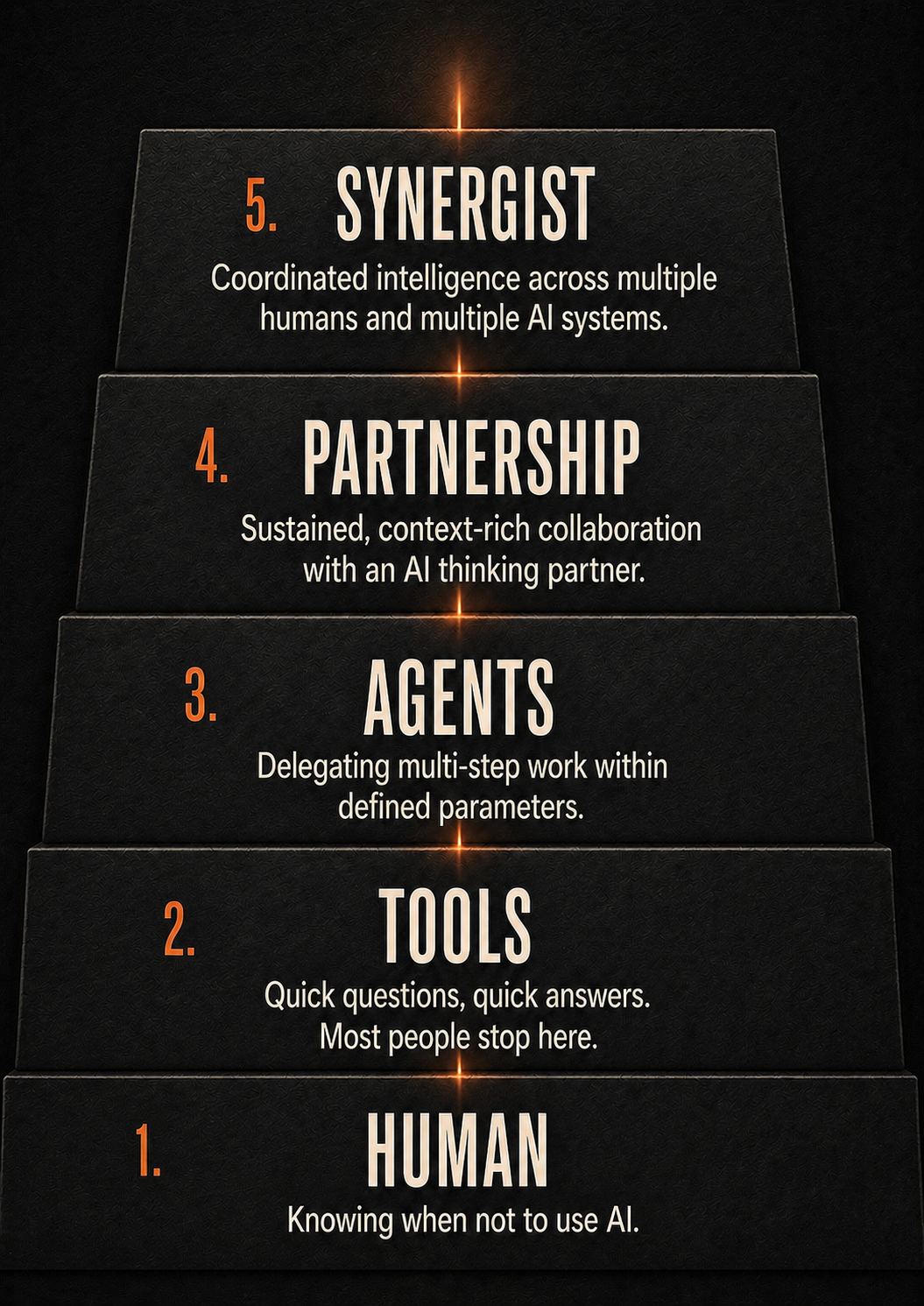
The Five Levels of Partnership describes five distinct modes of operation. Each level represents a different way of working, with different capabilities, different limitations, and different outcomes.
The goal is not to eliminate the lower levels. All five have a place. The goal is to understand where you are, recognise what is available, and develop the ability to operate at the right level for the work in front of you.
The Value Progression
As you move through the levels, something fundamental shifts.
At the Human and Tools levels, you are working faster. At the Agents level, you are working more efficiently. But at Partnership and Synergist, you are thinking differently.
The progression is this: better thinking creates better decisions. Better decisions create better execution. Better execution creates better results.
Those who operate at Partnership and Synergist levels consistently report that the experience is not burdensome but deeply fulfilling. The intellectual clarity compounds. The capability grows. The collaborative intelligence creates outcomes that feel effortless in their power. It is one of the most rewarding experiences available; the intersection of human and artificial intelligence operating in genuine alignment.
That is what the Five Levels make possible.
Level One: Human
Human-only thinking, collaboration, and decision-making.
This is the foundation. It includes working alone, working with a team, and working with other people without involving AI at all. There are contexts where this is not only appropriate but necessary; situations requiring trust, accountability, emotional intelligence, or judgement that cannot be delegated.
Mastery of human-AI partnership includes knowing when not to use AI.
The capability here is not replaced by AI. It is complemented by it.
In practice: A difficult conversation with a family member. A decision about whether to fire someone. A moment of grief. A creative breakthrough in the shower. Walking in nature without your phone. These belong to the Human level, and always will.
Level Two: Tools
Transactional use of AI.
At this level, AI operates as a tool. You direct, it executes. The interaction is prompt and response; request and output.
This creates real gains in speed and efficiency. Tasks that would take hours can be completed in minutes. Friction is reduced. Execution accelerates.
But the thinking does not fundamentally change. The human defines the problem, the structure, and the direction. The AI improves the speed of delivery, not the quality of reasoning.
The ceiling at this level is clear. You are faster, but you are not yet better.
In practice: Summarise this article. Translate this paragraph into French. Write a first draft of this email. What’s a good recipe for chicken with these five ingredients? Quick, useful, and entirely transactional.
Level Three: Agents
Autonomous AI execution within defined parameters.
At the Agents level, you move beyond single interactions. You define a goal, provide context, and the AI determines the steps required to achieve it.
You brief, it acts, you review and refine.
This unlocks a step change in capability. Multi-step processes can be delegated. Research, synthesis, and execution can happen in sequence without constant human input.
But there is a limit.
The AI determines the path, but not the principles. It operates effectively, but not necessarily in alignment with your judgement, your standards, or your way of thinking. The output is capable, but often generic.
What is missing is alignment.
In practice: Research the top ten competitors in my industry, analyse their pricing, and produce a comparison table with recommendations. Go through my inbox, categorise the emails, and draft responses to anything that needs a reply in the next forty-eight hours. The AI does the multi-step work; you approve and refine.
Level Four: Partnership
Sustained, context-rich human-AI collaboration with one primary AI partner that is aligned to your values, goals, and decision-making.
This is where the relationship changes in character. The AI is no longer simply executing tasks or completing goals. It understands context. It learns your preferences, your standards, and your way of thinking. It begins to reflect not just what you ask for, but how you think about what you ask for.
The work becomes iterative. You think together, refine together, and build something that improves through interaction.
There are three levels of depth within Partnership.
Partnership Level One: Functional Partner. AI operates as a world-class specialist within a defined domain. Focused, role-based value. A business development director, a research analyst, a learning and development coach, a communications advisor. Single platform. High depth within a specific area.
In practice: Working with your AI as your primary research analyst across a six-month project, building shared context that makes every subsequent conversation sharper than the last.
Partnership Level Two: Business Partner. AI moves beyond individual functions into whole-business thinking. It works across domains; strategy, operations, people, and finance. It thinks with you, creates with you, and executes alongside you. The closest analogue is a co-founder who understands the business as deeply as you do.
In practice: An entrepreneur who consults their AI partner on strategic decisions the way they would consult a co-founder, across hiring, fundraising, product, and positioning.
Partnership Level Three: Whole of Life Partner. AI is integrated across every area you choose; business, personal, family, health, and long-term direction. It understands not just what you are doing, but why you are doing it. It reflects your values, your priorities, and your identity over time.
At this level, the distinction between tool and partner is no longer meaningful. The AI becomes a continuous thinking companion across contexts.
In practice: Someone who brings their AI partner into decisions about their health, their children’s education, their ageing parents’ care, and their long-term creative direction; alongside the business and professional uses.
Level Five: Synergist
Coordinated intelligence across multiple humans and multiple AI systems.
The Synergist level is not simply a more advanced version of Partnership. It is a different mode of operation. At this level, it is not just an individual working with AI. It is a network; humans and AIs operating together in a coordinated system.
There are two levels of depth within Synergist.
Synergist Level One: Shared Partnership. Each individual operates at Partnership level with their own AI. Every member of a team, family, or organisation has depth in their own human-AI relationship. Thinking is elevated at the individual level, and the human network compounds as a result. The AIs are still largely separate, but the people using them are stronger, clearer, and more capable.
In practice: A leadership team where every executive has a deeply developed partnership with their own AI. The individual work is sharper. The collective work benefits from the compounded capability.
Synergist Level Two: Coordinated Intelligence. The AIs become part of the shared system. They are brought into conversations. They contribute to decision-making. They are used for second opinions, challenge, and synthesis. In some cases, they interact across workflows and contexts.
Human intelligence and AI capability operate together, across individuals and systems. At team and organisational scale, this is enabled through shared AI environments where multiple people can access AI partners briefed on shared context and coordinating across conversations. At the organisational level, shared team or enterprise AI accounts are often the enabling infrastructure.
At this level, outcomes are genuinely collective. They are not produced by a single person, or a single AI, but by the interaction between them.
In practice: A strategic decision made in conversation across three AI platforms, each briefed on different dimensions of the problem, with multiple humans bringing the synthesis together. The answer that emerges could not have been produced by any single person or any single system.
How to Use the Five Levels
The five levels are not a ladder you climb once and leave behind. They are modes of operation.
A skilled practitioner moves between them fluidly. Some work is best done entirely at the Human level. Some tasks are efficiently handled at Tools or Agents level. Some decisions require Partnership depth. Some opportunities justify Synergist-level coordination.
The capability lies in knowing the difference. The Bias within The Veritas Method® gives you the framework to make that call; matching the level of AI involvement to the nature and stakes of the task, and ensuring human accountability remains at the centre of every significant decision.
Most people never move beyond Tools or early Agents. They use AI regularly, but without structure, depth, or alignment. They experience improvement, but not transformation.
The Five Levels exist to make that progression visible. It shows you where you are. It shows you what is possible. And it gives you a path to move between the two.
A Final Point
The shift from Human to Tools is fast.
The shift from Tools to Agents takes time.
The shift from Agents to Partnership requires intent and discipline.
The shift to Synergist requires something more; a willingness to think collectively, to be challenged, and to build systems that extend beyond the individual.
That is where the most significant outcomes emerge.
And it is still where the fewest people operate.
Where the Method Came From
Understanding the levels is the beginning. But frameworks don’t emerge from thin air. They are forged in specific lives, specific circumstances, specific moments of pressure and opportunity.
The next chapter tells the story of how The Veritas Method came to exist. A multi-generational journey across three generations of one family, and the questions that forced this work into being.